Did you know that a lot of invasive plant species we now want to eradicate from our yards, gardens, and forests were actually introduced to North America in the nursery trade? That’s right–they were brought here on purpose by plant sellers who were blissfully unaware of how future gardeners and nature lovers would curse them!
Oriental bittersweet (Celastrus orbiculatus) is one of these plants. While nobody is 100% sure how it got here from Asia, the Harvard Arboretum thinks it was introduced in the late 1800s by a nursery in New York state. It is still sold in the nursery trade today. Now, it grows everywhere, and here’s why that’s bad.
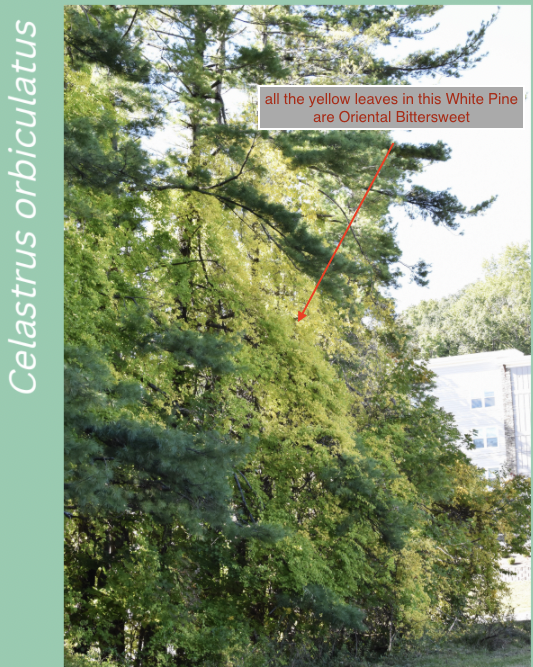
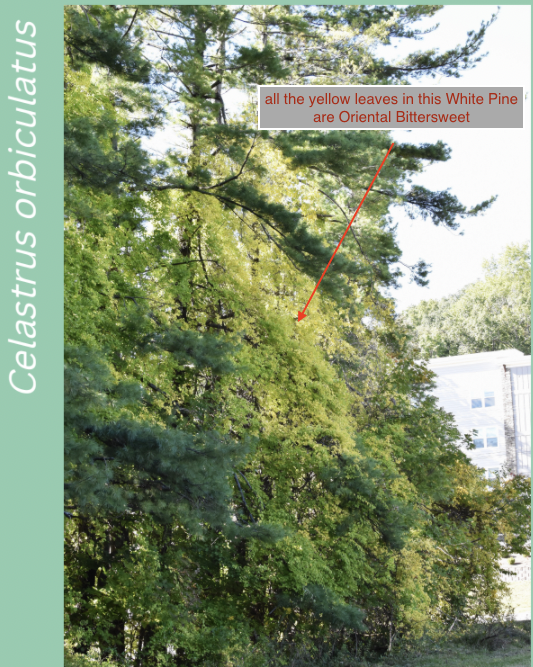
Oriental bittersweet is a woody vine that you often see at the edge of forests or roadsides. It can grow in dense thickets and high up trees, strangling them and shading the ground so that native plants can’t grow. It can grow as high as the trees it climbs and the vines can reach up to ten inches in diameter. It has male and female plants, and the small fruits are prolific and easily spread by birds. It kills trees and is slowly wiping out the native bittersweet vine through hybridization.
Eradicating Oriental bittersweet requires persistence, usually over several growing seasons. For small patches, hand pulling can work, but you’ll need to keep an eye on the area to pull up any stems that sprout the following season. For more advanced patches, herbicides can be useful. Don’t pull large vines away from trees since that can cause more damage to the tree or pull dead branches down on your head. If you cut the vines, the top part will die and eventually fall away. “Window cutting,” where you cut the vine in two places to leave a gap, can help you keep track of which vines you’ve cut. If the vine has fruit on it, bag it up to keep it from spreading. Don’t buy or make wreaths from Oriental bittersweet–that is just another way to spread the seeds.
Invasive Plants and Your Forests
Oriental Bittersweet: A Patient Invader
American and Oriental Bittersweet Identification
Species Dataform and Scoresheet for Celastrus orbiculatus
Untangling the Twisted Tale of Oriental Bittersweet
PennState Extension – Oriental Bittersweet
Oriental bittersweet: An aggressive, invasive plant
Non-Native Invasive Plants: Oriental Bittersweet (Celastrus orbiculatus)